

Ford truck fans are in a league of their own, which is no surprise since the Ford F-Series of trucks is also in a league all its own. As your Ford dealer near you, there are few things we love more than talking with our customers about the Ford vehicles they drive and enjoy every day. Over the years, we’ve found that the incredible legacy of Ford trucks and the F-150, in particular, is one of the topics that people really get excited about. And we certainly don’t blame them.
The Ford F-150 has been America’s best selling truck for more than 40 years – that kind of legacy is something that no other vehicle can match. In honor of that, we thought it would be fun to take a look back at where the F-150 has come from and the kinds of changes and different forms it’s taken over the years. We’ll also cast our gaze forward and consider where we’re headed and what the future of the F-150 might look like. Whether you’re a long-time Ford truck fan or interested in getting your first taste of what the F-150 has to offer, this is for you.
How It Started: The Ford Model TT Pickup
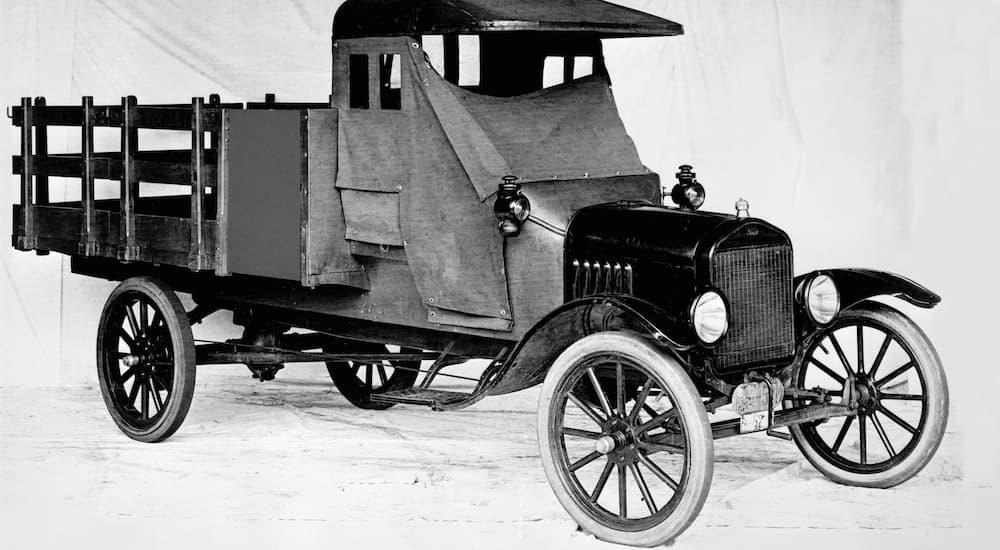
Although it’s tempting to just jump right in with where the Ford F-150 got rolling, we think it’s more fun to look at the history of Ford trucks, in general, to see how we got here. The F-150 itself wasn’t introduced until 1975, and the F-Series didn’t hit the road until 1947, but the first Ford truck rolled off of the factory in 1917, more than 100 years ago. A lot of people don’t realize that Ford has been in the truck game that long, but once you think of it that way, then it’s no surprise that they’ve learned how to make the best truck in America.
Of course, the Model TT Pickup that was available in 1917 was a far cry from the Ford F-150 of today – not only in terms of performance but also design. It was based on the Model T but offered a sturdier frame for a bed or other platform to be built onto it. In fact, at the time, it was essentially just an engine, frame, and cab – the customer had to build on their own body. It wasn’t until 1925 that someone could buy a fully assembled truck from Ford with a frame, body, and everything else necessary.
While the Model TT kicked things off for Ford in terms of truck design, it was not the only model available prior to the F-Series. Model AA and Model BB trucks, based on Ford’s Model A and Model B cars, were available in the years that followed, and they were all very popular among construction workers, farmers, and others with similar needs. In 1935, Ford released the Model 50 truck that was similar to a car introduced in the same year. It was successful but still based on a car design; its production ended in 1941 when Ford put all of its production capacity to work for the US Army as we entered World War II.
Post-War Pickup: The Ford F-Series
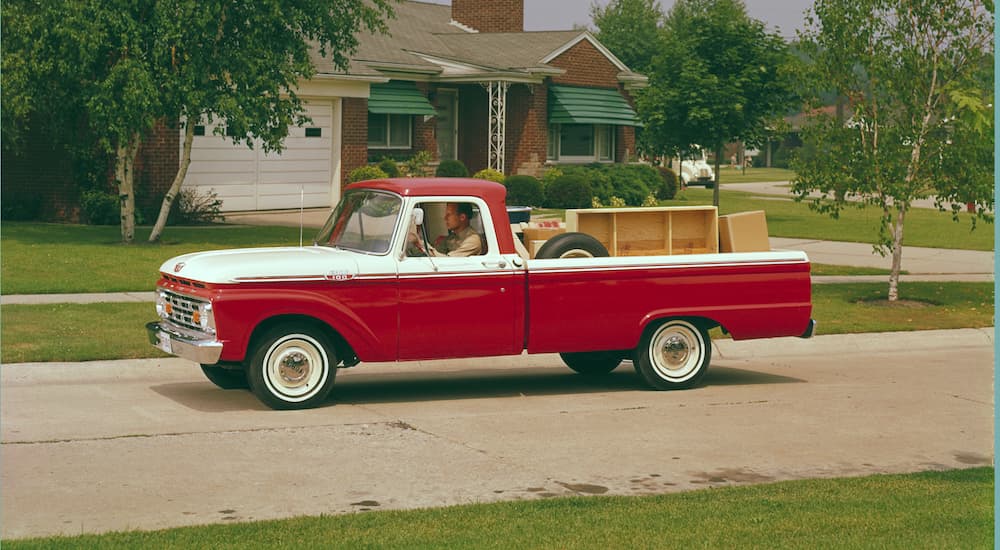
Following WWII, Ford needed something new to capture the attention of Post-War America, and they began developing a new type of truck. Rather than being based on a similar car, like their previous trucks had been, the new pickup they were working on was its own thing with an all-new platform purpose-built for a truck. In 1947, this design came to fruition when Ford introduced the first F-Series trucks to the world.
The first generation of the Ford F-Series kicked off with the 1948 model year and ran through 1952, offering a full-size pickup that blew away everything else on the road. That first generation used a different naming convention than the modern F-Series, though it was somewhat similar. Eight different models were available, increasing from the Ford F-1 to F-8 with greater payload capacity and power as the numbers went up. The Ford F-1 was a half-ton truck, followed by three-quarter-ton F-2 and F-3 models and a full-ton F-4.
When the second generation of the F-Series launched for the 1953 model year, the names were changed to what we now recognize, with three digits rather than just one. The half-ton model became the F-100, followed by a three-quarter-ton F-250, a one-ton F-350, and medium-duty F-500 and F-600 models. As you can see, the F-150 we know and love today was still missing from this lineup, and that remained the case throughout several generations that followed.
Forging a Legacy: Birth of the Ford F-150
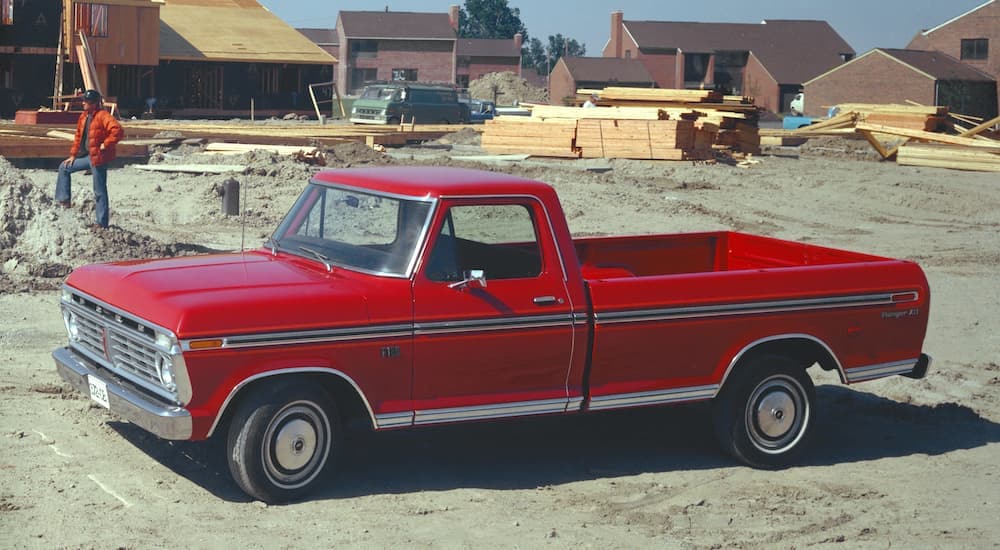
The sixth generation of the Ford F-Series of trucks kicked off with the 1973 model year, and this is where things were changed forever. In the midst of this generation, in 1975, Ford introduced the F-150 as an option designed to offer greater payload and muscle than the F-100 without going all the way up to the capabilities of the F-250. It should come as no surprise that this proved to be a very popular option – for several years that followed, however, both the F-100 and F-150 remained available.
Ford kicked off the 1980s with the seventh generation of the Ford F-Series of trucks for the 1980 model year. Advertised as the “First new truck of the 1980s,” this marked the first full redesign for the F-Series since 1964. As you might expect, that was huge, and a lot of what we still associate with Ford truck design came about with this new generation. Also of note is that this generation was the last time the Ford F-100 was available: production on it came to an end in 1983 as the F-150 proved a far-more popular option.
Although there were numerous changes made for the eighth generation of the F-Series in 1987 and the ninth generation in 1992, both generations were still largely based on many of the core aspects of the Ford truck introduced in 1980. In 1997, for its tenth generation, Ford decided to effectively divide the F-Series into two lineups: the standard F-150 and the F-250 and F-350 models that became the Ford Super Duty trucks in 1999. This generation also marked a major redesign for the F-Series, with a fully independent front suspension and other changes.
Since that time, the F-150 and Ford F-Series, in general, has been updated several times: the eleventh generation in 2004 was built on an all-new platform, the twelfth generation and thirteenth generation were based on this platform, and the fourteenth generation for the 2021 model year redesigned 92% of its parts. This was one of the biggest redesigns of the last 20 years and has completely refreshed the F-150 for a new generation of drivers. This includes some of the most powerful and impressive engines we’ve ever seen, including an all-new full-hybrid PowerBoost engine that offers incredible performance and terrific gas mileage.
Looking Ahead: The Future of the F-150
As the Ford F-150 continues to dominate the truck market, there’s no denying that Ford could, if they wanted to, simply rest on their laurels and do well. That’s never been Ford’s style, however, so we’re already seeing what the future of the F-Series is going to look like thanks to the all-new F-150 Lightning. An all-electric version of the F-150, this pickup is going to revolutionize everything we’ve come to expect from Ford trucks. As the F-150 Lightning and similar EV pickups start to take the world by storm, we’re excited to see Ford continue leading the way just as they have for more than 100 years.
Connect with us


- February 2025
- January 2025
- November 2024
- October 2024
- September 2024
- August 2024
- July 2024
- June 2024
- May 2024
- April 2024
- March 2024
- February 2024
- December 2023
- November 2023
- October 2023
- September 2023
- August 2023
- July 2023
- June 2023
- May 2023
- April 2023
- March 2023
- February 2023
- January 2023
- December 2022
- November 2022
- October 2022
- September 2022
- August 2022
- July 2022
- June 2022
- May 2022
- April 2022
- March 2022
- February 2022
- January 2022
- December 2021
- November 2021
- September 2021